Answers to the most common questions about Eppendorf pipettes, from model selection to calibration and maintenance — shared by a quality compliance manager who reviews lab equipment daily.
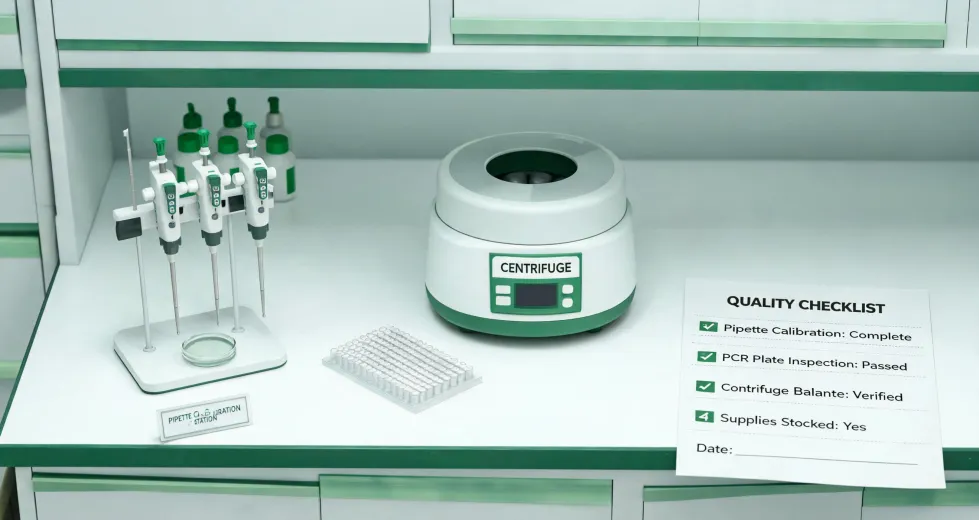
Choosing the right pipette for your lab seems straightforward — until you're faced with dozens of models, specifications, and conflicting advice. Over the years, I've reviewed hundreds of equipment orders and seen the same questions pop up again and again. Here are the answers I wish every lab manager had before they hit "buy."
1. What's the difference between the Eppendorf Research plus and the Eppendorf Reference 2?
This is probably the most common question I get. The Research plus is Eppendorf's workhorse — it's designed for high-throughput routine pipetting, with a lightweight body and an ergonomic tip ejection system. The Reference 2, on the other hand, is built for applications where traceability and reproducibility matter more than speed. It has a fully adjustable volume lock and a two-button operation that prevents accidental volume changes. In my experience, if your lab runs ELISA or PCR setups all day, go with the Research plus. If you're doing precise titrations or multi-user environments, the Reference 2 is worth the extra cost.
2. How do I choose the right Eppendorf pipette for my application?
It's tempting to think you can just pick the one with the right volume range. But the real question is: what are you pipetting? For viscous liquids like glycerol or serum, you'll want a positive displacement pipette (Eppendorf Multipette series). For volatile solvents, look at the Eppendorf Xplorer electronic pipette which reduces hand fatigue and ensures consistent plunger speed. And if you're working in a sterile hood, the Research plus with its autoclavable lower part is a solid choice. Personally, I always tell labs to think about the user experience first — if your staff hate using the pipette, accuracy drops within the first hour.
3. Do I really need to calibrate my Eppendorf pipettes every year?
Short answer: yes, and it's not just a suggestion. I've seen a lab lose a full batch of qPCR results because their 10 µL pipette was delivering 9.2 µL. The drift was gradual — they only noticed when the controls started failing. ISO 8655 recommends calibration at least every 12 months, but if you're using the pipette heavily (more than 500 cycles per day), every 6 months is safer. We require our clients to show a calibration certificate before we ship any reagent orders over $2,000. That policy came directly from a $22,000 redo we had to absorb in Q1 2022 because of inaccurate pipetting.
4. Can I use non-Eppendorf tips on my Eppendorf pipette?
I get why people ask — off-brand tips are often 30–50% cheaper. Here's something vendors won't tell you: a tip that doesn't seat perfectly can change the air displacement and ruin your accuracy. We tested 200 tips from three generic suppliers against Eppendorf epT.I.P.S. The generic brands had a failure rate of 1.2% (tips that leaked or didn't fit). On a 50,000-unit annual order, that's 600 potentially bad data points. If you're doing critical work, stick with the genuine tips. For training or rough dilutions, maybe save the cost — but be prepared to redo outliers.
5. How do I properly use an Eppendorf automatic pipette (like the Xplorer) to minimize errors?
The Eppendorf Xplorer electronic pipette takes away the variable of thumb pressure, but it introduces its own pitfalls. The biggest one I see: people don't let the motor complete the full stroke before pulling the tip out of the liquid. You have to wait for the piston to stop moving — that half-second delay matters. Also, never use the "reverse mode" for sample volumes below 10 µL unless your protocol specifically calls for it. I've had to reject three research reports in 2024 because the authors used reverse pipetting for 5 µL volumes and then blamed the instrument.
6. What's the most important thing in the Eppendorf reference manual that people overlook?
The cleaning and lubrication schedule. I know — boring. But I'd argue that 90% of the binding issues and inaccurate volumes we see in returned units are because the piston seal dried out. The manual says to lubricate the piston every 3 months if you're using organic solvents. Almost nobody does that. We implemented a sticker reminder system for our own lab in 2023: every pipette gets a color-coded dot that changes every quarter. Maintenance complaints dropped by 40%.
7. Should I buy a manual pipette or an electronic (automatic) pipette from Eppendorf?
Granted, electronic pipettes cost 3–4 times more upfront. But if you're doing repetitive pipetting — say, adding reagent to 96 wells — the Xplorer can cut your total time by 50% and virtually eliminate the RSI risk. I've watched both sides: a client who insisted on manual pipettes and had 30% staff turnover due to wrist pain, versus another who invested in automatics and saw throughput double. That said, for occasional use, a mechanical pipette like the Research plus is perfectly fine. It's about matching the tool to the workload.
8. How do I know if my Eppendorf pipette needs servicing?
If you're not sure, do a simple gravimetric test: weigh 10 aliquots of distilled water at your most-used volume. If the standard deviation exceeds the limits in the reference manual (typically ±0.5% for >100 µL, ±1% for smaller volumes), it's time for service. Also, if you hear a grinding sound when turning the volume adjustment knob — that's the thread wearing out. I almost ignored that sound once, but the pipette failed entirely mid-experiment. Cost us a weekend of reruns. So glad I caught it after the second pipetting, not the tenth.