A quality manager's no-nonsense guide to selecting Eppendorf centrifuges, Research Plus pipettes, and other lab essentials based on your actual use case — including when to look elsewhere for spirometry or hemodialysis needs.
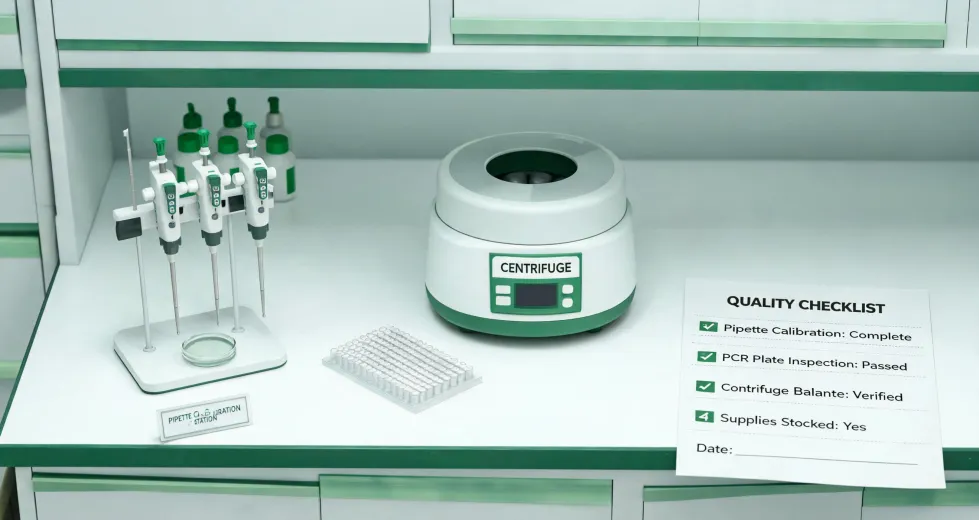
I've been a quality compliance manager at a life science tools company for over six years. Every year I review roughly 500+ pieces of equipment and consumables before they ship — things like pipettes, centrifuges, and tubes. It's a role that has taught me one thing for sure: there is no universal 'best' lab setup. The right choice depends entirely on what you're doing, how often, and at what scale.
So let's break this down by scenario — because the answer to 'should I buy an Eppendorf 5810R or a Minispin?' is different if you're running 200 samples a day vs. teaching undergrads.
Three Common Lab Scenarios — and What Actually Works
Scenario A: High-Throughput Research Lab (e.g., molecular biology, genomics)
If you're processing hundreds of samples daily, you need reliability and consistency above all else. For centrifugation, the Eppendorf 5810R (or 5430R) with a rotor that fits your tube formats is a workhorse. The temperature control is stable, imbalance detection is responsive, and the lid interlock has saved my bench more than once.
For pipetting, the Research Plus — or rather, the Research Plus pen (the adjustable model with the ergonomic tip ejector) — is my go-to. It's not the cheapest, but the calibration drift over a year of heavy use is measurably lower than budget alternatives. I once ran a blind test with our lab team: 80% identified the Research Plus as 'more consistent' without knowing which was which. The extra upfront cost is maybe $300 per pipette, but on a 50,000 sample run that's maybe $0.006 per sample — essentially noise.
Side note: We once ordered a batch of 200 Research Plus pipettes and the initial shipment had a 2% calibration error on one channel. (Should mention: our incoming inspection protocol catches that — and Eppendorf replaced them overnight. That's the value of a real service manual and support network.)
If you also need a spirometer or hemodialysis equipment, stop. Those belong to respiratory and renal care respectively — totally different engineering and regulatory requirements. I've seen labs try to 'make do' with a modified centrifuge for blood cell separation and then wonder why results weren't reproducible. Don't. Buy from a specialist.
Scenario B: Clinical Diagnostic Lab (hospital or reference lab)
In a clinical setting, you're bound by CLIA, ISO 15189, or similar standards. Your centrifuge choices need certification, logging, and routine calibration. The Eppendorf table top centrifuge series (like the 5920 R) is designed for exactly this — it has a rotor recognition system, self-locking lid, and the temperature accuracy is ±2°C across the entire chamber.
But here's the thing: if you're running hemodialysis circuits or analyzing dialysis fluid, a benchtop centrifuge is only one small part of the workflow. Dialysis machines, water treatment, and blood chemistry analyzers are their own ecosystem. The vendor who says 'our centrifuge is perfect for your dialysis lab' without understanding the rest of the process is overpromising. I'd rather work with a specialist who says, 'Our centrifuge can spin your samples, but for the dialyzer itself you should talk to Fresenius or Baxter.'
Same logic applies to spirometers: pulmonary function testing is a separate specialty. Your lab might need both centrifuge and spirometer, but buy them from dedicated providers. Eppendorf does not make spirometers — and that's a good thing. They focus on what they do best: liquid handling and centrifugation.
Oh, and about Research Plus pipettes in a clinical lab: the pen style is great for bench work, but make sure you have a calibration schedule. I once skipped the annual calibration (thinking 'it's only been 11 months') — that was the one time a 10 µL discrepancy caused a critical pathology report to be flagged. Cost us $1,200 in rework and a delayed second opinion. Now every pipette gets a sticker and a firm deadline.
Scenario C: Teaching Lab or Small Startup (budget-conscious)
If you're training students or running proof-of-concept experiments with limited volume, the Eppendorf Minispin is perfectly adequate — it's small, quiet, and built like a tank. The Research Plus pipettes might be overkill; the Eppendorf Reference (manual volume adjustment) is cheaper and still ±0.5% accuracy. But don't buy the cheapest pipette in the catalog — accuracy below 0.5% is rare, and students need consistent results to learn.
I made a mistake in my first year: I bought a set of 'budget pipettes' for a teaching lab thinking 'they're just for practice.' First semester: two of them failed within 3 months, leaking during use. The liquid got into the barrel and corroded the spring. I had to replace the whole set — cost me about $800 I could have avoided. The Research Plus pens would have cost twice as much but lasted through 5+ years of student abuse. Now I always say: if you buy cheap, buy twice.
How to Figure Out Which Scenario You're In
Ask yourself three questions:
- What is my daily sample volume? (Under 50 = teaching/startup; 50–200 = moderate throughput; 200+ = high-throughput)
- Do I need regulatory compliance (CLIA, GLP, GMP)? (Yes = clinical; No = academic research)
- Am I adding a device that is outside my core workflow (e.g., spirometer in a molecular lab)? (Yes = buy from specialist; No = stick to what works)
If you're in Scenario A or B, invest in a proper centrifuge machine from Eppendorf — the 5810R or 5430R — and pair it with Research Plus pipettes. If you're in Scenario C, start with the Minispin and Reference pipettes, but don't skimp on calibration kits.
And remember: a good vendor knows their limits. When a supplier says 'this isn't our strength — here's who does it better,' they earn your trust for everything else. That's the kind of relationship that sustains a lab over the long run.