An experienced lab administrator answers your toughest questions on Eppendorf centrifuge error codes, PCR machine pricing, and lab equipment total cost of ownership.
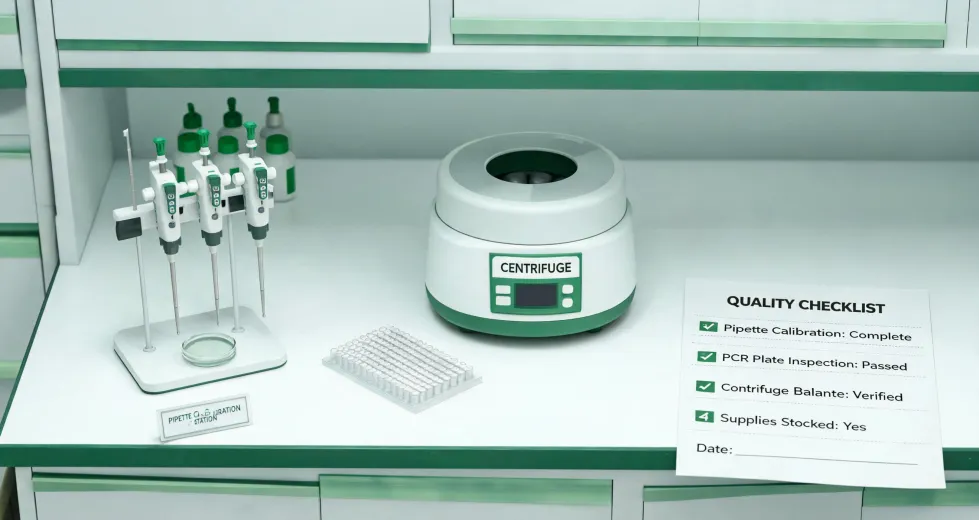
Let's be real. If you manage lab purchasing for a research facility, biotech, or a hospital, you're not just buying equipment. You're buying reliability, service support, and (hopefully) an easy path to getting approval from finance. I manage this for a mid-sized lab group, processing orders for everything from pipette tips to centrifuges. Here are the questions I always get asked about the big-ticket items, and the answers I wish I had known sooner.
What does the Eppendorf Centrifuge 5702 'Error 3' mean?
This one gave me a headache the first time it popped up. Basically, Error 3 on a 5702 series indicates a rotor identification failure. The machine can't properly communicate with the rotor to confirm its type and max speed. The usual suspect? A dirty or corroded contact pin on the rotor itself or inside the centrifuge chamber.
Here's the thing: Most people panic and think the motor is dead. It usually isn't. The fix is often simpler than that. Clean the contact points with a lint-free cloth and some isopropyl alcohol. If that doesn't work, you might need to replace a small sensor board. I've seen facilities ignore this for days (ugh), forcing them to use a backup machine and delaying sample processing.
I spent hours digging through service manuals (note to self: always keep a printed copy) before figuring this out. The online forums were useless. Save yourself the stress: check the contacts first.
How much does an Eppendorf PCR machine price get me?
This is the question everyone asks. But 'how much' is the wrong starting point. The right question is: 'What does that price include?'
When I was pricing out a Mastercycler for our new sequencing core in 2024, the quotes varied wildly. The Eppendorf PCR machine price can range from roughly $8,000 for a basic 48-well model to over $25,000 for a high-end 384-well system with a gradient function and touchscreen. But the base price on the invoice is just the beginning. Let's break down the total cost of ownership (TCO):
- Installation & Qualification (IQ/OQ): Does the quote include on-site installation and performance verification? Many don't. That's an extra $500–1,500.
- Extended Warranty: The standard is one year. Extending to three years is smart but adds cost.
- Consumable Compatibility: Eppendorf machines are great, but you need compatible tubes and plates. Check if your existing stock works.
Looking back, I should have asked for a turnkey price (equipment, installation, and a 2-year warranty) instead of just the machine cost. It saves budget fights later.
How does an autoclave work? (And why should I care about the brand?)
This is a classic 'outsider blindspot' question. An autoclave isn't just a fancy pressure cooker. Per standard lab protocol, it uses steam at a specific temperature (typically 121°C or 134°C) under pressure to sterilize equipment and waste.
The key principle is moist heat sterilization. The high temperature denatures proteins and kills microorganisms, including spores. The pressure is crucial because it allows the steam to reach these high temperatures (well above the boiling point of water). It's one of the most reliable methods for decontamination in a BSL-2 or higher lab.
Most buyers focus on the chamber size and price. They completely miss the validation cycle capabilities. A cheap autoclave might 'run a cycle' but fail a spore test (Bowie-Dick test). In a clinical setting, a failed test means shut down your lab until you fix it. That's a risk cost you can't ignore. It's better to get a unit from a reputable supplier like Systec or Tuttnauer for critical work than to gamble on a no-name import. The TCO is lower when you account for downtime.
Is a 'neonatal incubator' different from a standard lab incubator?
Completely different, and confusing them is a costly mistake. A standard lab incubator (like the Eppendorf CellXpert or Galaxy series) is for growing cells in culture. It controls CO2, temperature, and humidity. A neonatal incubator is for human infants. It has vastly different requirements for temperature uniformity, humidity, oxygen control, and patient safety.
Important note for administrators: If you're ordering for a clinical or NICU setting, you must specify a 'neonatal incubator' or 'infant warmer.' They are regulated medical devices, often requiring specific certifications (like FDA 510(k)). Quoting a standard lab incubator, even a highly accurate one, for a neonatal application is a safety violation.
When I consolidated orders for 400 employees across 3 locations in 2022, I caught a requisition that was trying to buy a Galaxy 170 R for a NICU! The price wasn't the issue—the function was. This is where knowing your internal client's use-case is critical.
Why not just buy a cheap blood pressure monitor for the lab?
I fought this battle in 2020. Our lab group wanted a monitor for our on-site health screening office. The finance team saw a $30 wrist cuff on Amazon and asked, 'Why pay $150 for a validated model from Omron or a clinical supplier?'
Here's my honest take: Accuracy and validation. Those $30 units are rarely validated against a standard mercury sphygmomanometer per AAMI/ESH protocols. For a screening, you need reliable data. A validated monitor (like those from Omron, Welch Allyn, or a clinical-grade model) ensures the reading is within 3 mmHg of the standard.
I knew I should push back on the cheap model, but I thought, 'What are the odds it's that bad?' Well, the odds caught up with me. The first time we used it, the readings were 15 mmHg off. The employee ended up in the hospital for a false alarm. The doctor was furious. We now require a validation certificate for any medical measurement device. That $30 monitor cost us $300 in wasted time and trust (and a very awkward meeting with the VP).
In 2025, managing lab procurement is about more than just getting the best price. It's about understanding the total cost of ownership—the installation fees, the validation steps, the support contracts, and the risk of delays. An Eppendorf centrifuge with a known error code fix is a better buy than a discount model with a two-week service lead time. Ask the right questions upstream, and you'll save yourself (and your finance team) a lot of headaches downstream.