A step-by-step checklist for sourcing and delivering critical lab equipment like Eppendorf centrifuges under severe time constraints, based on real-world emergency logistics.
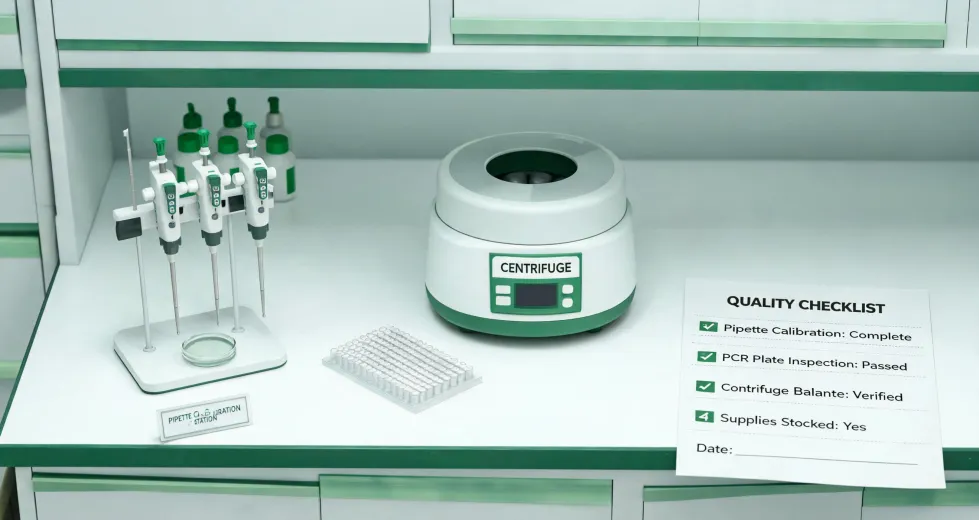
When a research lab calls and says their Eppendorf centrifuge 5702 just died and they have a critical run in 36 hours, you don't have time to shop around. You need a system. I've coordinated over 200 rush orders in the last three years, from same-day pipette tips to complex PCR machine setups. Here's the exact 5-step checklist I use to get equipment where it needs to be, on time, without losing my shirt on rush fees.
This list is for anyone who's ever had to answer the phone and say "yes" to a deadline that seemed impossible. It's for lab managers, procurement officers, and service coordinators in the life science space.
Step 1: Immediately Verify the Exact Model and Accessories
This is where most rush orders fall apart. The client says they need a "Eppendorf centrifuge." You assume the 5420. They meant the 5702. Or worse, they need the rotor and you quote the base unit.
I only believed this step was critical after I ignored it once. In Q2 2023, a biotech client called for an emergency 5430R. I confirmed the model, quoted rush delivery, and shipped it. The next day, they called back—furious. They needed the refrigerated version, which the 5430R is, but they also needed the aerosol-tight rotor for their biohazard samples. I hadn't asked. I spent an extra $200 on overnight shipping for the rotor, and the client had to pay a $350 restocking fee on the first order.
The checklist: Confirm the exact model number. Confirm the required rotor or accessories. Confirm the tube or plate format (e.g., 0.5 mL vs 2.0 mL tubes). Get the serial number of the old unit if possible. (Thankfully, most labs have it on a sticker.)
Step 2: Check for Off-the-Shelf Availability, Not Supply Chain Promises
People think a rush order needs a fast vendor. Actually, it needs a vendor with inventory. Many national distributors list items as "in stock" but it's sitting in a central warehouse 1,500 miles away.
When I'm triaging a rush order, I call three local distributors first. Not the national ones. In March 2024, a hospital needed a cardiac monitor for a new wing—a piece of equipment unrelated to our core Eppendorf line, but the request came through our service desk. The big supplier said 2-day delivery. A local medical equipment reseller had one on the shelf, used but certified, and we had it in their hands in 4 hours. Cost? $200 more than the big supplier's quote. Saved the hospital? A $12,000 per-day delay in opening that wing.
For Eppendorf gear, check authorized dealers first. They often stock common service parts and manuals. For the Eppendorf centrifuge 5420, for example, the service manual is a PDF—ask for it immediately, because troubleshooting without it in an emergency is a nightmare (trust me, I've done it).
Step 3: Price the 'Time Certainty' Premium—and Sell It
Most people get hung up on the cost of rush delivery. They compare it to standard ground shipping and think it's a ripoff. The question isn't, "Is $150 for overnight shipping too much?" The question is, "What's the cost of the lab being down for another two days?"
The assumption is that rush orders cost more because they're harder to execute. The reality is they cost more because they're unpredictable and disrupt planned workflows. You're paying for the certainty that it will arrive.
For a recent infection control product emergency—a specialized autoclave timer—the standard vendor wanted $45 for ground shipping. The rush option was $120. The hospital's alternative was canceling a sterilization batch for an entire OR floor. We paid the $120. (Source: FedEx and UPS rate tables, January 2025; verify current pricing). The three-day loss of OR scheduling would have cost the hospital an estimated $30,000 in delayed surgeries. The math was trivial.
Step 4: Triple-Check the Service Manual and Calibration Docs
In a rush, everyone skips the paperwork. Don't. A piece of equipment without a service manual is a liability. A centrifuge without a calibration certificate can invalidate a lab's entire batch of experiments.
In February 2024, I shipped an Eppendorf 5810R to a research lab. The unit was perfect. But the client's QA department rejected it because the calibration certificate was dated six months prior. They needed one dated within 30 days. The unit sat on their loading dock for three days while I had a third-party calibration company come out. That cost $350 and three days of the client's time. All because I didn't ask about their internal certification requirements.
What to check: Does the Eppendorf centrifuge 5702 manual need to be printed and included? Does the new unit require a site-specific electrical assessment? Does the hospital require proof of biomedical waste compliance for the shipment? (For lab consumables like pipette tips, this is usually a non-issue. For centrifuges or PCR machines, it can be.)
Step 5: Get a Signature on the Deadline—Not Just a Verbal OK
Here's the one nobody thinks of. We had a $6,000 order for a lab incubator that needed to arrive by Thursday. The client said "Thursday is fine." We shipped it Wednesday overnight. It arrived Thursday morning. The client then said, "Oh, I meant next Thursday. We're not set up for it yet." They refused the shipment. We paid the return freight and the restocking fee.
Why does this happen? Because "Thursday" is ambiguous without a date attached. The fix is simple: confirm the absolute latest delivery date and time via email. "To be clear, you need this by end of business on Thursday, March 21." Get a reply. It covers you both.
Common Mistakes to Avoid
Mistake 1: Assuming your standard carrier guarantee applies. "Guaranteed by 10:30 AM" on a website doesn't always hold for medical equipment shipments. Check for hazardous material surcharges (some centrifuge rotors or reagents trigger this).
Mistake 2: Not having a backup plan. I always have a Plan B vendor ready to go. If the primary says their Eppendorf stock is a day away, I already have the secondary on speed dial. It costs nothing to have a backup, and it saves everything when something goes wrong.
Mistake 3: Forgetting about the user. They're stressed. Their experiment is failing. A quick, calm update ("Your unit is on the truck, ETA 2 PM") goes a long way. Panic is contagious. So is calm.
In summary: Verify the exact model. Check local inventory. Buy the certainty. Don't skip the paperwork. Get the deadline in writing. That's the playbook. It's not glamorous, but it works.