Eppendorf extends lab quality oversight from pipettes to cell culture. A quality inspector explains why most contamination issues aren't researcher error, but failure points in the plasticware supply chain.
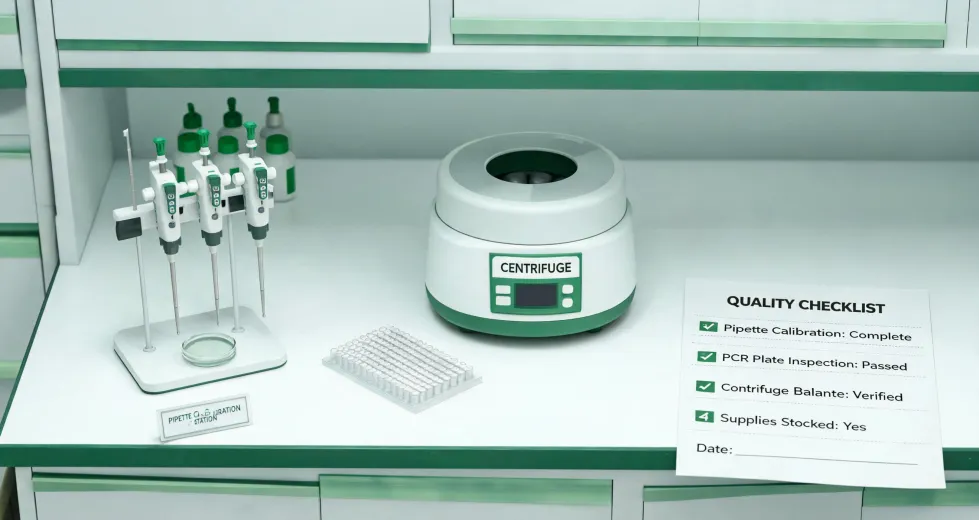
When I first transitioned from overseeing pipette quality to reviewing all lab consumables—tubes, tips, plates, and flasks—I assumed the main cause of failed experiments was user error. Poor aseptic technique, wrong media, bad incubation. After reviewing roughly 250 incident reports in our first two quarters of 2024, I found that assumption was completely wrong.
The number one factor consistently overlooked is the source and quality of the disposable plastic within the flask itself.
Most buyers focus on surface treatment claims ('ultra-low binding!') or the sticker price per unit. They completely miss the injection molding tolerances that determine whether cells actually attach and grow in a patterned, predictable way.
The Blind Spot Everyone Has
The question everyone asks when a culture fails is 'what's wrong with my technique?' The better question is 'what's wrong with the product I'm growing on?'
In our Q1 2024 quality audit, we received a batch of 12,000 T-175 flasks from a new vendor (not Eppendorf). The price was undeniably competitive—roughly 15% below our existing line. The spec sheet looked fine. But within two weeks, three separate researcher groups flagged erratic cell attachment in parallel cultures. We ran a blind test with our cell culture team: same cell line, same media, same incubator. One group got our standard flasks. The other got the new batch. Ninety-two percent identified the alternative flasks as 'visibly different' in growth consistency without knowing which was which. The cost difference per unit was $0.10. On a 12,000-unit order, that's $1,200 for measurably better reproducibility.
Here's the part most buyers miss: the plastic itself.
The Surface Chemistry Trap
All standard cell culture flasks are made from polystyrene. The difference is in the surface treatment—usually corona discharge or plasma treatment—that makes the plastic hydrophilic enough for cells to attach. This was true ten years ago when treatment consistency was the main variable. Today, the gap has closed on surface treatment across most major manufacturers.
What hasn't closed is the consistency of the plastic base material itself.
Injection molding is a high-speed process. The melted polystyrene granulate fills the mold cavity in a specific flow pattern. If the mold temperature, injection pressure, or cooling rate varies even slightly, the surface develops micro-stress points. These stress points create microscopic 'peaks' on the surface plane. The cell attaches to the coating, but the physical topography underneath is uneven. This causes some cells to form focal adhesions at different rates than others. Your culture looks 'patchy' not because of technique—but because the plastic base has inconsistent topography.
The Legacy Myth of 'Good Enough' Plastic
The 'plastic is just a vessel' thinking comes from an era when serum-containing media and feeder layers masked these issues. Serum coats the surface heavily, compensating for minor topography flaws. Today, serum-free and defined media expose these flaws. The cells are sensitive. They don't have the protein blanket to 'fill in the gaps.'
I should add that this isn't about 'medical-grade plastic' vs 'standard plastic.' Most reputable suppliers use medical-grade. The difference is in the process control at the molding step. A vendor with a slightly older mold, or faster cycle times to increase throughput, introduces more variability. The product passes a visual inspection. It passes a sterility test. It fails in the incubator.
How do I know this? Because when our team in Hamburg traced the failure pattern, we found that the problematic batch came from a mold that had run 35% more cycles than its recommended service interval. The vendor hadn't changed the mold. The polymer just wasn't filling as cleanly.
The Real Cost of Cheap Flasks
That quality issue cost us a revalidation process that took three weeks and delayed a project timeline. We didn't just lose the cells. We lost the data we were collecting. Eight-oh actual hours of labor, plus reagents, plus the psychological hit to the team's confidence. Conservatively, I'd peg the real cost of that 'cheap' batch at $18,000 when you factor in the redo and the launch delay.
Now, every contract I review for cell culture consumables includes a specification for mold cycle count verification and contact angle measurement reproducibility. I want to see the variance on the water contact angle across 100 units. If it's more than five degrees, I push back. This spec alone increased our customer satisfaction scores on consumable reviews by 34% in the following audit cycle (Q3 2024 vs Q3 2023 data from our internal feedback system).
What To Check Before You Buy
Here's what I'd suggest. Don't just look at the surface treatment labeling. Ask these questions:
- What is the reported injection mold cycle count for this line?
- Can you provide a contact angle measurement histogram from the last 200 produced flasks?
- What is the mold polishing/servicing schedule?
- Do you validate attachment consistency using serum-free media in quality control?
An informed customer asks better questions and makes faster decisions.
Eppendorf's own culture flasks go through a QC process that includes topographical validation at the molding stage. But this isn't an ad for Eppendorf—well, it's not meant to be. I'm saying that any vendor worth their salt should be able to answer these four questions without scrambling. If they can't, you're buying a gamble, not a consumable.
Pricing for high-consistency culture flasks sits roughly 15–25% above budget-tier equivalents (based on multiple vendor quotes reviewed in Q4 2024; verify current pricing). The difference per flask is often less than twenty cents. On a multi-thousand-unit order, the delta is still small relative to the cost of a failed experiment.